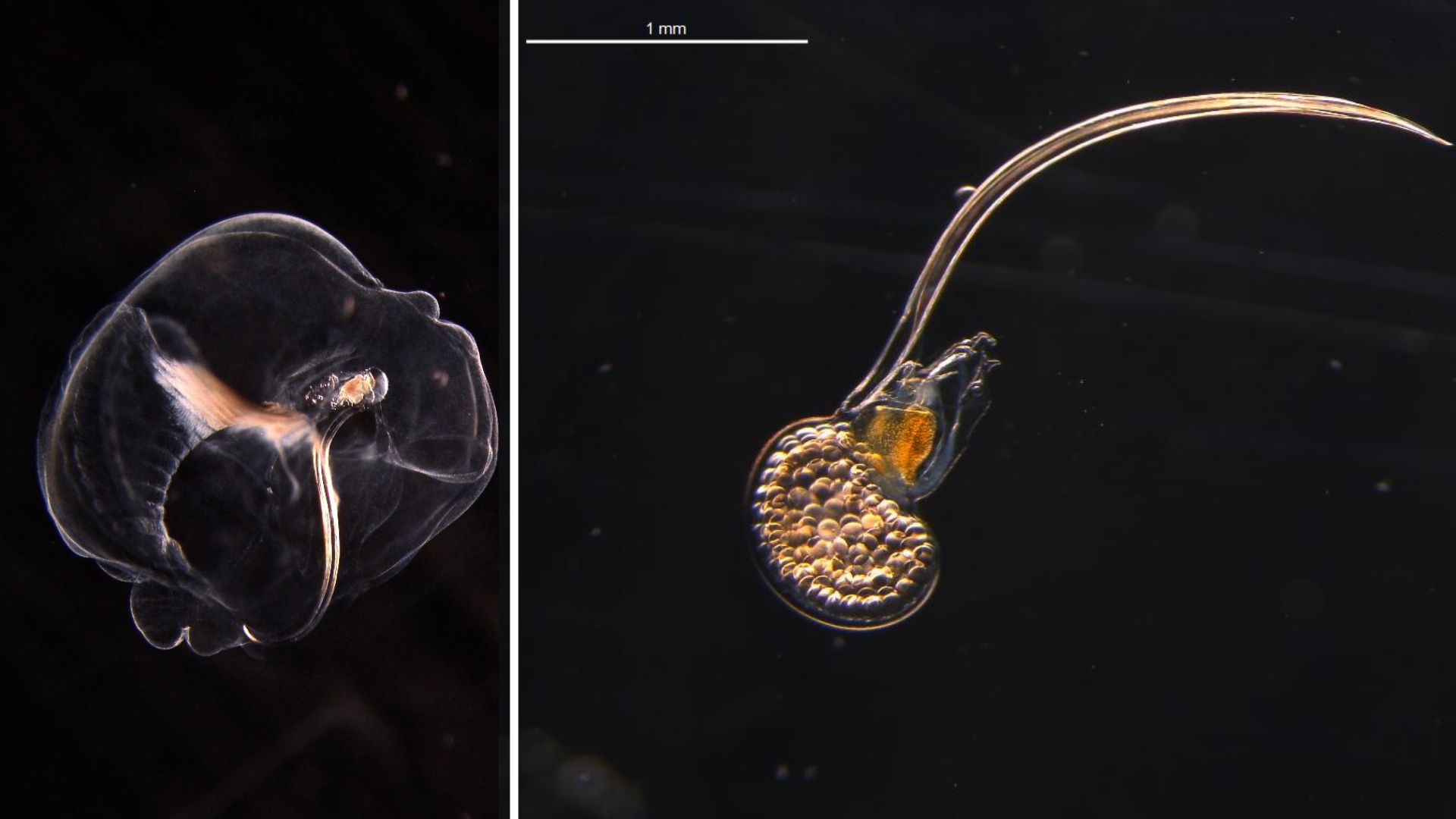
Two specimens of Oikopleura dioica, one with a mucus house which it uses to filter microscopic food particles (left) and one without (right).
Copyright OIST (Okinawa Institute of Science and Technology Graduate University, 沖縄科学技術大学院大学).
https://www.oist.jp/image/two-photographs-oikopleura-dioica
Video of Oikopleura dioica – Igor Adameyko
Oikopleura dioica is a small pelagic tunicate of the class Appendicularia (AKA larvaceans) found in the surface waters of temperate to tropical oceans worldwide. This species is a planktonic chordate: it drifts with the ocean current and has a spinal cord equivalent
It has a tadpole-shaped body, with a small ovoid trunk 0.5–1 mm long, and a thin tail approximately four times the trunk length, for a total length about 2-3 mm.
It maintains a notochord throughout life, distinguishing it from most other tunicates that lose this structure in adulthood
It is transparent, which, along with its simple structure (~4000 cells in functional juveniles), makes it useful for developmental biology studies
It lives inside a self-secreted mucous “house” which it uses to capture suspended food particles, pumping water through its “house” with movements of its tail
Oikopleura dioica possesses exactly two dopaminergic neurons in its central nervous system, which has about 130 neurons. These neurons form a highly miniaturized motor control circuit that is functionally reminiscent of the vertebrate nigrostriatal system. The two dopaminergic cells project to a small set of inhibitory (GABAergic) neurons, regulating movement in a manner similar to basal ganglia action in vertebrates.
A scientific study of this circuit:
(knockout of the dopamine neurons produced weakly moving “parkinsonian” animals)
A miniaturized nigrostriatal-like circuit regulating locomotor performance in a protochordate
https://www.sciencedirect.com/science/article/pii/S0960982223010588
