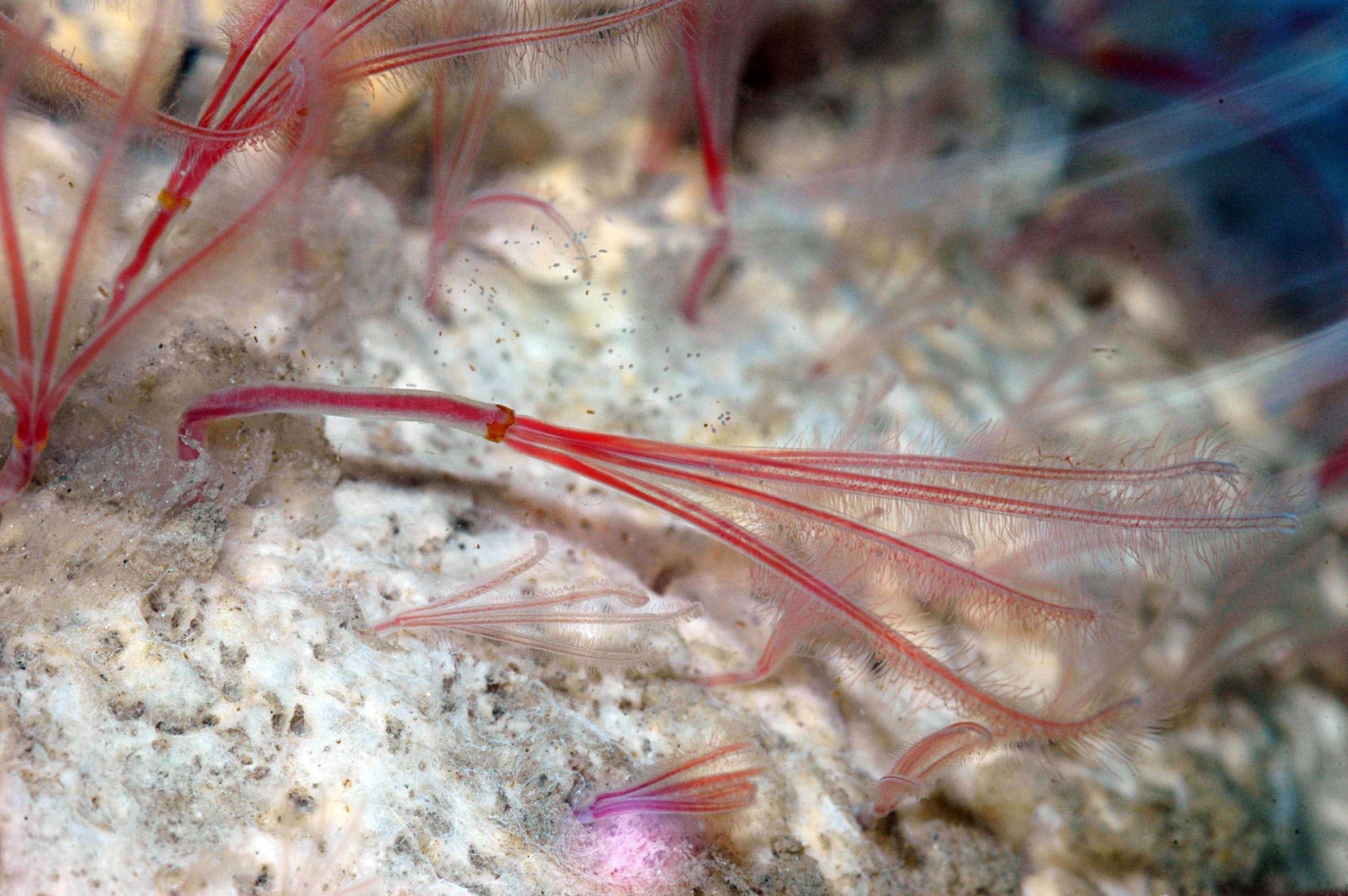
32 species, all but one with extreme sexual dimorphism
“Roots” in the bones use bacteria to break down bone, feathery structures outside the bones take in oxygen
Youtube video 4 minutes
Recently the expected Osedax were not seen on bones, YAEW (yet another environmental worry)
YAEW as opposed to YHWH
Yahweh (also spelled YHWH or the Tetragrammaton) is the personal covenant name of the God of Israel in the Hebrew Bible, appearing more than 6,200 times throughout the Old Testament. The name first appears in Genesis 2:4 and is written in Hebrew as יהוה (Yod-Heh-Waw-Heh).biblehub+1
Etymology and Meaning
The name is most likely derived from the Hebrew verb hayah, meaning “to be,” “to exist,” or “to bring into being”. This connection is reinforced in Exodus 3:14, where God reveals himself to Moses as “I am who I am” (ehyeh asher ehyeh), directly relating the name to concepts of eternal existence and self-sufficiency. The pronunciation “Yahweh” is supported by the shortened form “Yah” found in biblical texts and by analysis of related Hebrew verb forms.gotquestions+4
Historical Origins
Archaeological evidence indicates that Yahweh worship predates Moses, contrary to the biblical narrative. The oldest reference comes from an Egyptian inscription dated between 1390 and 1352 BCE, mentioning “YHWA in the Land of the Shasu,” referring to a place associated with nomadic peoples from Midian and Edom. Yahweh was originally an ancient Semitic deity in the southeastern Levant who became the national god of the Iron Age kingdoms of Israel and Judah.wikipedia+2
Pronunciation and Usage
Beginning around the 3rd century BCE, Jews developed the practice of never pronouncing the divine name out of reverence, instead substituting words like “Adonai” (Lord) or “Hashem” (The Name). The name consists entirely of vowel letters in Hebrew, which when spoken slowly would be “ee-ah-oo-ey” and when spoken quickly becomes “Yahweh”.eliyah+1
Wikipedia summary of Osedax
Like other siboglinids, Osedax lacks a mouth, gut, or anus, and instead depends on colonies of endosymbiont microbes housed inside a trophosome for nutrition. Unlike other siboglinids, however, this trophosome takes the form of a vascularized root system which penatrates bone.[1][4] These microbes, of the order Oceanospirillales, produce enzymes which hydrolyze collagen from bones, yielding nutrition to the worms.[4][1][5][6][7] Osedax exhibit very drastic sexual dimorphism, with females being >20,000 times larger than males.[8] Males are paedomorphic and microscopic, inhabiting a section of the females’ trunk where they produce sperm from yolk reserves
Journal Science, 2004: Osedax: Bone-Eating Marine Worms with Dwarf Males
We describe a new genus, Osedax, and two new species of annelids with females that consume the bones of dead whales via ramifying roots. Molecular and morphological evidence revealed that Osedax belongs to the Siboglinidae, which includes pogonophoran and vestimentiferan worms from deep-sea vents, seeps, and anoxic basins. Osedax has skewed sex ratios with numerous dwarf (paedomorphic) males that live in the tubes of females. DNA sequences reveal that the two Osedax species diverged about 42 million years ago and currently maintain large populations ranging from 105 to 106 adult females.
What are siboglinidae?
Siboglinidae is a family of polychaete annelid worms that includes around 100 species commonly known as tubeworms. The family name originates from Siboglinum, the first described genus, which French biologist Maurice Caullery named after the H.M.S. Siboga, the expedition vessel that collected the original specimens from the Malay Archipelago in 1914. Caullery placed this genus in the new family Siboglinidae, and this family name is now firmly established to represent worms formerly classified as the separate phyla Pogonophora (beard worms) and Vestimentifera (giant tube worms).wikipedia+3
Body Structure
Siboglinids have bodies divided into four distinct regions. The anterior cephalic lobe bears one to over 200 thin, ciliated tentacles with tiny side branches called pinnules. Behind this is a glandular forepart that secretes the chitinous tube the worm inhabits. The trunk forms the elongated main body with various annuli, papillae, and ciliary tracts, while the posterior opisthosoma is a short, segmented region with paired chaetae that anchor the animal inside its tube.gbif+1
Unique Digestive and Nutritional Features
Adult siboglinids completely lack a mouth, gut, and anus—a remarkable trait for non-parasitic animals. Instead, they rely on chemosynthetic bacteria housed in a specialized organ called the trophosome for nutrition. These endosymbiotic bacteria colonize the larvae after settlement through horizontal transmission and provide nutrients by metabolizing sulfide-rich compounds from their deep-sea environments.sciencedirect+2
Habitat and Size
These worms inhabit chitinous tubes either buried in sediment or attached to hard substrates at ocean depths ranging from 100 to 10,000 meters. Most species are less than 1 millimeter in diameter but can reach lengths of 10 to 75 centimeters. The tubes are often clustered in large colonies containing thousands of individuals at hydrothermal vents, cold seeps, and organic-rich sediments.wikipedia+1
https://academic.oup.com/book/38846/chapter/337765410
https://www.sciencedirect.com/topics/agricultural-and-biological-sciences/siboglinidae
https://en.wikipedia.org/wiki/Siboglinidae
https://pmc.ncbi.nlm.nih.gov/articles/PMC7143560/
https://journals.plos.org/plosone/article?id=10.1371%2Fjournal.pone.0016309
https://www.gbif.org/species/112708238
https://comptes-rendus.academie-sciences.fr/biologies/articles/10.1016/j.crvi.2008.10.007/
https://www.sciencedirect.com/topics/biochemistry-genetics-and-molecular-biology/siboglinidae
https://www.britannica.com/animal/Siboglinum-weberi
https://www.frontiersin.org/journals/marine-science/articles/10.3389/fmars.2021.793645/full
https://pmc.ncbi.nlm.nih.gov/articles/PMC3038861/
http://nathanwhelan.com/assests/Li_et_al_2016_Siboglinidae_phylogenomics.pdf
http://www.marinespecies.org/aphia.php?p=taxdetails&id=129103
https://www.vliz.be/imisdocs/publications/ocrd/136067.pdf
https://onlinelibrary.wiley.com/doi/10.1111/j.1096-0031.2004.00039.x
More about the Siboga, just in case you want to know
HMS Siboga (more commonly just Siboga) was a small Dutch naval gunboat converted into a research vessel for a major zoological and hydrographic expedition in the seas of the former Netherlands East Indies (now Indonesia) from 1899 to 1900. It is best known for the “Siboga Expedition,” which became one of the most influential early oceanographic and biological surveys of Southeast Asian waters.wikipedia+2
The ship itself
The Siboga was a twin‑screw gunboat a little over 50 meters long, launched in Amsterdam in 1898 and then sent to the East Indies. It was adapted from its military role to carry scientific equipment, laboratories, and living quarters for scientists while still being robust enough for work in poorly charted tropical waters.hydro-international+1
- Built as a Dutch gunboat but specially refitted for research work.journal.iagi+1
- Carried winches, dredging gear, trawls, sounding machines, and space for large specimen collections.hydro-international+1
The Siboga Expedition (1899–1900)
The Siboga Expedition was a year‑long scientific cruise around the Indonesian archipelago that ran from March 1899 to February 1900. The ship sailed from Surabaya (Java) and covered roughly 12,000 nautical miles, focusing on deep and shallow marine environments, coral reefs, and hydrography.lindahall+2
- Led by zoologist Max Carl Wilhelm Weber with a team that included his wife, algologist Anna Weber‑van Bosse, and several zoological assistants.wikipedia+1
- The expedition carried ten Dutch naval officers, about 45 local crew, six scientists, and support staff, reflecting its dual naval and scientific nature.hydro-international
Scientific work on board
The expedition combined biological collecting with systematic sounding and seafloor sampling, which was advanced for the time. Operations routinely involved stopping the ship to lower nets, dredges, and thermometers into deep waters and then processing the catch in makeshift shipboard labs.lindahall+2
- Conducted around 181 deep‑sea soundings, 103 trawl stations, and 96 dredge stations, often in poorly charted and reef‑strewn waters.hydro-international
- Collected enormous numbers of specimens; nearly half of all specimens examined later were found to be new to science, including at least 131 new fish species described by Weber.abebooks+1
Key people and their roles
Several figures associated with Siboga became prominent in marine science and naval hydrography.wikipedia+2
- Max Weber: Zoologist and overall scientific leader, responsible for designing the research program and later editing the vast publication series “Siboga‑Expeditie.”lindahall+1
- Anna Weber‑van Bosse: Specialist in marine algae and one of the first women to participate as a full scientist on a major oceanographic expedition; later honoured by Dutch and French orders.wikipedia+1
- Gustaaf Frederik Tydeman: Naval officer and captain of Siboga, an experienced hydrographer who oversaw navigation, sounding, and chart improvement, later becoming a vice admiral.lindahall+1
Lasting impact
The work done from HMS Siboga had a long‑term impact on oceanography, biogeography, and taxonomy, especially for the Indo‑Australian region.doi.pangaea+2
- Produced a multi‑decade series of at least 148 scientific monographs (“Siboga‑Expeditie”) covering zoology, botany, geology, and oceanography, many still cited for baseline species descriptions.abebooks+2
- Helped clarify patterns around Wallace’s Line and the division between Asian and Australian marine faunas, greatly enriching knowledge of coral reefs and deep‑sea basins in Indonesia.journal.iagi+1
https://commons.wikimedia.org/wiki/File:Siboga,_gunboat_(1898).jpg
https://en.wikipedia.org/wiki/Siboga_expedition
https://www.hydro-international.com/content/article/the-siboga-expedition
https://www.lindahall.org/about/news/scientist-of-the-day/max-weber/
https://www.usni.org/magazines/naval-history-magazine/1998/october/sinking-hms-pegasus
https://journal.iagi.or.id/index.php/FOSI/article/download/120/90
https://www.abebooks.com/servlet/SearchResults?tn=Die+Tunicaten+der+Siboga-Expedition
https://www.facebook.com/groups/157095571308248/posts/1653978271619963/
Osedax worms use palps and pinnules
The oxygen-extracting structures in Osedax are typically referred to as “palps” and “pinnules” rather than gills, though they function as the primary respiratory surfaces. The anterior crown consists of highly vascularized palps bearing numerous side branches called pinnules, which are densely ciliated and create a large surface area optimized for oxygen uptake from seawater. These elaborate branchial structures facilitate high oxygen consumption by possessing short diffusion distances and a large surface-to-volume ratio.pmc.ncbi.nlm.nih+1
The palps and pinnules are structurally analogous to the anterior branchial plumes found in vestimentiferan tubeworms. Each pinnule is largely filled by a blood cavity forming a pinnular loop that efficiently exchanges gases. The terminology reflects their morphological origin from the cephalic lobe region rather than true segmental gill structures, though functionally they serve the same respiratory purpose.pmc.ncbi.nlm.nih
The trunk epidermis plays only a minor role in gas exchange due to its thicker structure, shorter ciliary bands, and lack of obvious respiratory specializations. The oxygen absorbed at the palps is then transported via the blood vascular system to supply the highly vascularized root structure embedded in bones, where aerobic heterotrophic endosymbionts require substantial oxygen for metabolism.royalsocietypublishing+1
https://fr.pensoft.net/article/167615/
https://pmc.ncbi.nlm.nih.gov/articles/PMC3338503/
https://journals.plos.org/plosone/article?id=10.1371%2Fjournal.pone.0140341
https://journals.asm.org/doi/10.1128/mbio.03140-22
https://en.wikipedia.org/wiki/Osedax
https://www.journals.uchicago.edu/doi/pdfplus/10.1086/BBLv220n2p128
The males are tiny! Links to pictures
Osedax, commonly called bone-eating or “zombie” worms, exhibits one of the most extreme cases of sexual dimorphism in the animal kingdom, with females being over 20,000 times larger than their microscopic dwarf males. The males live inside the gelatinous tube surrounding the female’s trunk, with 50-600 males forming a “harem” within a single female.microbialmenagerie+1
Visualization of Males Inside Females
The best images documenting this remarkable reproductive arrangement come from detailed scientific microscopy studies. Research published in the journal Invertebrate Biology includes transmission electron microscopy (TEM) and fluorescence microscopy images showing sperm from dwarf males located throughout the ovarian tissue of female Osedax. The study examined four species (O. rubiplumus, O. frankpressi, O. “green palps,” and O. “yellow collar”) and used Hoechst nuclear staining to reveal sperm with their characteristic helical nuclei distributed near the ovarian ducts.scripps.ucsd+1
Light microscopy images show the males as microscopic larvae-like organisms living within the female’s tube lumen, primarily concentrated in the anterior third near the oviduct. The males remain at the larval stage, never developing into full adults, and produce sperm from yolk reserves.wikipedia+1
Reproductive Biology
The males measure only micrometers in length while females can reach several centimeters. This extreme size difference evolved because male dwarfism prevents competition with females for food and space on the limited resource of sunken bones. The sperm from these microscopic males penetrate through the thin oviduct and travel to the ovarian tissue where fertilization occurs internally. Rather than being stored in discrete structures, the sperm are found dispersed throughout the connective tissue near the ovarian ducts, in close proximity to developing oocytes.nationalgeographic+4
https://www.oceannetworks.ca/news-and-stories/stories/where-are-the-zombie-worms/
https://microbialmenagerie.com/osedax-zombie-worms-microbe-endosymbiont/
https://en.wikipedia.org/wiki/Osedax
https://scripps.ucsd.edu/news/story-bizarre-deep-sea-bone-worm-takes-unexpected-twist
https://pmc.ncbi.nlm.nih.gov/articles/PMC4285288/
https://www.nationalgeographic.com/animals/article/_zombie_-worms-mate-inside-whale-bones
http://chargedmagazine.org/2020/11/the-undersea-bone-devourer/
https://www.montereybayaquarium.org/animals/animals-a-to-z/whale-worm
https://today.ucsd.edu/story/the_story_of_a_bizarre_deep_sea_bone_worm_takes_an_unexpected_twist
https://www.mbari.org/news/a-motley-collection-of-boneworms/
https://pmc.ncbi.nlm.nih.gov/articles/PMC10984269/
https://onlinelibrary.wiley.com/doi/10.1111/ivb.12037
https://revistapesquisa.fapesp.br/en/creatures-deep/
https://www.sciencedirect.com/org/science/article/pii/S1313298919004397
https://news.uvic.ca/media-release/where-are-the-zombie-worms/
https://www.alamy.com/stock-photo/osedax-worm.html
https://www.facebook.com/groups/457674185029274/posts/1269133680549983/

.jpg)